Ameren is planning to reduce jobs
By Michael D. Sorkin and Jeffrey Tomich
©2005, St. Louis Post-Dispatch
Tuesday, Nov. 29 2005
Ameren Corp. executives have told workers to expect a "significant reduction"
in staff in some departments in the next three years as part of efforts to cut
operating costs by $65 million.
An Ameren spokeswoman couldn't say how soon jobs would be eliminated or how
many of the company's 9,300 employees would be affected.
"It depends upon what you consider 'significant,'" spokeswoman Susan Gallagher
said Tuesday. "We don't have a definite target on the number of people."
She said some of the cuts might be achieved through attrition.
The company has 2.3 million electric customers and 900,000 natural gas
customers in Missouri and Illinois. Its total operating and maintenance costs
are about $1.4 billion a year.
The company wants to reduce operating expenses in its corporate services
division by 15 percent. That division includes the finance, human resources and
communications departments, among others, Gallagher said.
The reductions won't affect "the people who climb the poles or generate the
power," she said.
Chuck Bremer, vice president for information technology, and several other
managers met Nov. 14 at Ameren's headquarters on Chouteau Avenue with leaders
of some of the company's unions to discuss the reductions.
The company discussed employee cutbacks without spelling out who or how many,
said Mike Walter, a business representative for IBEW Local 1439, which
represents about 850 linemen, warehouse workers, mechanics and other employees.
The cuts probably would come mainly "in management areas," Walter said. "But we
really don't know."
From the point of view of the consumer, cost-cutting is good, he said. "It will
keep rates down."
Ameren is on pace to post record revenue and profit in 2005, mostly because of
last year's purchase of Illinois Power Co.
Walter said he didn't expect further cutbacks among the employees who make
repairs. That number already has been reduced in recent years, he said.
Don Giljum, business manager for Operating Engineers Local 148, said the
company was more specific with his union. It represents about 1,450 employees
who operate and maintain power plants.
"Of that, they want to cut 125," Giljum said.
But Gallagher said Ameren was still deciding where to cut costs, and executives
had not given the unions any specific figures on employee cutbacks.
Giljum said Ameren planned to subcontract some work while cutting the benefits
of other workers.
"When is enough enough?" he said. "They keep cutting us back, working us more
overtime and all in the name of profits."
Sunday, December 04, 2005


Posted 11:17 AM November 29, 2005
Boy lights up Circle
11-year-old flips switch on Indy's Christmas tree
Diana.Lamirand@Topics.com
December 1, 2005
Ben Bonne, 11, (left) of Lawrence helps Santa Claus greet holiday well-wishers Friday night before flipping the switch on the 43rd annual light display on the Soldiers & Sailors Monument in downtown Indianapolis. -- Matt Detrich / Indianapolis Star
LAWRENCE -- It had been six years since 11-year-old Ben Bonne attended The Circle of Lights annual lighting and holiday kickoff ceremony in downtown Indianapolis.
"I was really little," said the Lawrence Township sixth-grader, who was 5 when his family took him to see the lighting ceremony. "Now we just watch it on TV."
This year, however, the Bonnes had a front-row seat at Friday's event.
The Contractors of Quality Connection and Electrical Workers of IBEW 481 selected Ben's drawing --an American flag and the Soldiers & Sailors Monument cast in a yellow glow from Christmas lights -- as this year's coloring contest winner. As his prize, Ben got to flip the switch to turn on the 4,784 lights that are hung from the monument in the shape of a Christmas tree.
"I was really surprised. I never thought they'd pick mine," Ben said of the creative and festive drawing that was randomly chosen from more than 3,400 entries.
Ben, the son of Henri and Catherine Bonne, entered the contest after seeing it posted in The Indianapolis Star.
"He loves to draw," Catherine Bonne said, explaining how Ben has taken art classes at The Art Center in Broad Ripple for about five years.
"It's kind of cool," his dad said of Ben's entry. "It's completely original. He created the whole thing."
The Fall Creek Valley Middle School student and his family attended a VIP reception before flipping the light switch and stood front and center on the main stage with Indianapolis Mayor Bart Peterson and Santa Claus during the festivities. The event also featured festive acts from entertainers throughout the state and ended with a fireworks display.
Event organizers expected nearly 100,000 spectators.
Call staff writer Diana Lamirand at (317) 444-5571.
"Second Bananna" as LA Engineers try to catch up with IBEW Local 18 (LA) Success
Second Banana
Does Antonio have anything to fear from Robert Aquino’s white-collar union?
by JEFFREY ANDERSON, DECEMBER 2 - 8, 2005
A demonstration at the airport on Sunday by 90 of the 9,000 members of the Engineers and Architects Association (EAA) was a reminder that the city’s salary structure is out of whack — and that someday, the mayor and the City Council must deal with pay disparities between thousands of city workers and those at the Department of Water and Power.
The job action, which included a strike threat, places EAA boss Robert Aquino in heavy company alongside Brian D’Arcy, head of the International Brotherhood of Electrical Workers (IBEW) Local 18. Last summer, D’Arcy, whose union controls 95 percent of the DWP work force, threatened to strike and forced the city to approve raises between 16 percent and 30 percent over five years, after city workers settled last year for 6 percent over three years.
Aquino seeks parity with the IBEW and cost-of-living increases to match the gains that D’Arcy won recently. It’s debatable whether Aquino — pronounced “A-Quee-No” — belongs on the same stage as D’Arcy. Or whether he has chosen the right time to demand parity between his members and members of the IBEW, who already make up to 60 percent more than city workers who perform the same or similar jobs as their counterparts at the DWP.
There are signs that Aquino presides over a disengaged membership that is not interested in a bloody battle. Observers wonder whether anyone will notice if the EAA strikes. Aquino’s style and background, coupled with his methods and the EAA’s unique history, also have the city’s labor community wondering what, if anything, he can accomplish.
Aquino set the EAA on its current course long ago. Sources say he abruptly declared an impasse with the city in 2004, and that for the second time in five years he has left his membership without a contract for more than a year. On November 20, a group of 400 EAA members approved job actions “up to and including strike” by a voice vote. Two days later, on the Tuesday before Thanksgiving, EAA members piled into City Hall as Aquino announced his intent to strike if the city does not meet his demands. His members include police crime-lab workers, computer technicians, airport-runway supervisors and management analysts. Aquino claims that in 129 out of the 140 job classes the IBEW and EAA have in common, IBEW members earn more. “EAA members are treated as three-fifths of an [IBEW member],” he said. Aquino did not return calls for comment.
Last Sunday’s demonstration was supposed to slow down airport traffic and show Mayor Antonio Villaraigosa that Aquino means business. Holiday travelers, much less Villaraigosa, barely noticed. With the city facing a $248 million deficit, the mayor already has said he cannot afford what Aquino is asking for. “It would be irresponsible for me and the city to provide a raise anywhere near what’s being asked for right now,” he said.
Villaraigosa can thank himself for this confrontation, labor observers say. The IBEW deal, which expanded an existing pay disparity between DWP and city workers, was quietly negotiated during the mayoral transition. Once the deal was exposed, city officials scrambled to deflect responsibility. Villaraigosa took several different positions. Aided by the L.A. Times, which has ignored what remains a mystery in City Hall, he blamed the deal on the Hahn administration. Then he hid behind a private attorney’s opinion citing the potential for an IBEW lawsuit against the city if it rejected the deal, despite an opinion from the City Attorney’s Office that the council could renegotiate in good faith.
Unlike Aquino, D’Arcy had more than bluster working in his favor. He is an old ally of Villaraigosa’s. The IBEW broke from the County Federation of Labor in endorsing Villaraigosa and spent more than $300,000 to see Hahn defeated. With command of the DWP work force and no DWP strike plan in place, D’Arcy purportedly has the ability to shut down the city. The EAA also backed Villaraigosa, and spent more than $100,000 on his behalf. But Aquino could have trouble mustering support within his own ranks to back up his tough talk, EAA members say.
The EAA’s highest-paid members earn more than $100,000 per year. It is considered a white-collar union whose members don’t naturally think “union.” In questioning Aquino’s leadership, some members say he has little or no strike fund to weather a work stoppage, which could fail to sufficiently disrupt city services and force concessions anyway. Others say he is driven by the percentage of dues he can reap from large salary increases.
“The cake has been cut,” EAA member Leroy Beavers, a payroll worker in the Controller’s Office, said on Tuesday. He was among 10 members who voted against the job action. City unions are under contract until 2007, Beavers says. The IBEW is locked in for the next five years. “EAA is over a year late with this action,” he noted.
Others said most EAA members are not paying much attention. Rodger Shimatsu, a management analyst with the Board of Public Works, called the 400-member voice vote “a travesty.” In an e-mail to fellow members, obtained by the Weekly, he wrote, “Is it not strange that only 400 members should dictate the future of 8,000 members?” On Tuesday, he said, “If we go out on strike, screw it, I’m working. Most of the analysts I know feel the same way.” Another EAA member, who requested anonymity, said a lot of members would cross the picket line, some by accident because it would be so small they would miss it. The EAA member called the job actions “foolhardy.”
The Weekly spoke to the leaders of five city unions this week. All expressed their support for any union that can gain a better wage for its members. They all acknowledged that the IBEW’s recent settlement raised the expectations of workers citywide. They stated their convictions that the city has made a mess of the pay structure among similar job classes across union and departmental lines. But on the condition of anonymity, several of them said Aquino is out on a limb without the credibility or the clout to achieve much success for his own members or for the greater labor community.
For starters, there is a process for negotiating that some say Aquino has bucked. In 2004, sources say, he walked away after one meeting when the city refused his demand for cost-of-living increases just shy of what firefighters are getting: 8.5 percent over three years. Then there is his temperament. Recently, he publicly called out Martin Ludlow, leader of the County Federation of Labor, before the issuance of a strike-sanction letter that is the customary first step toward bringing the federation together to discuss whether to throw its collective weight behind a particular union. According to Jim Hilfenhaus, public-affairs director of Laborers’ Union Local 300, when Service Employees International Union (SEIU) Local 347 leader Julie Butcher’s car was torched earlier this year, Aquino cracked, “If it were me, it wouldn’t have been her car.” Hilfenhaus also recalls Aquino bursting into the County Fed’s endorsement meeting before the mayoral election to loudly throw his support to Villaraigosa. “No one knew who he was. People said ‘Who is this lunatic?’ ” Hilfenhaus said.
“Maybe he has a mandate to be militant, but he looks as if he’s going to self-destruct,” said one city labor leader. “He’s completely swimming upstream,” said another. “This is what it looks like to go it alone,” said a third.
Pat McOsker, head of the United Firefighters of Los Angeles, said, “Maybe I’m in the minority, but I’m not bothered by what Bob is doing. Time will tell if he’s chosen effective methods.”
Aquino is a former Teamster. Though there is much talk about his rough-and-tumble past, details are hard to come by. In 1991, news reports state that Aquino was among 13 business agents who tried to force the resignation of a controversial chief officer of Teamsters Local 63 named Robert Marciel, who had been accused of ballot fraud by court-appointed Teamsters election officials. Marciel fired Aquino in July 1991, according to news reports, which annotated that local’s troubled history with a recap of a 1988 federal jury award of $768,000, after several union members were attacked while walking to a nominating meeting. Marciel was a defendant but was found not personally liable.
Aquino took over the EAA around 1999 or 2000, sources say. It had been a conservative shop, run by Bob Duncan, for the previous 25 years. The EAA was large, unaffiliated and thought to be the most Democratic union in the city, veteran labor leaders say. Aquino, after having worked with the father of an EAA board member, came in claiming to have bargaining experience with a warehouse unit of the Teamsters, labor leaders say. He possesses a hard-nosed style reminiscent of the old Teamsters.
The EAA has a complicated history. The IBEW has tried for years to take it over, losing a tough decertification fight in the late 1990s, around the same time that close to 1,000 EAA members at the DWP accepted buyouts due to cost cutting. Several years later, the IBEW and SEIU Local 347 filed competing decertification petitions, which led the EAA to affiliate with the International Union of Police Associations. The Employee Relations Board rejected the SEIU’s petition in 2004, and by then close to 1,000 EAA members at the DWP voted to join the IBEW.
The IBEW’s increased membership helped shore up D’Arcy’s dominance of the nation’s largest public utility. Former EAA members at the DWP promptly received generous raises and a taste of the preferential treatment that IBEW members have long enjoyed. Meanwhile, in 2004, Aquino made an unsuccessful bid to unionize more than 200 aides to City Council members, on the heels of an unsuccessful bid to unionize city senior personnel analysts.
Now Aquino is looking to ride D’Arcy’s coattails, as the city braces for another chapter in the slow grind toward pay equity.
Does Antonio have anything to fear from Robert Aquino’s white-collar union?
by JEFFREY ANDERSON, DECEMBER 2 - 8, 2005
A demonstration at the airport on Sunday by 90 of the 9,000 members of the Engineers and Architects Association (EAA) was a reminder that the city’s salary structure is out of whack — and that someday, the mayor and the City Council must deal with pay disparities between thousands of city workers and those at the Department of Water and Power.
The job action, which included a strike threat, places EAA boss Robert Aquino in heavy company alongside Brian D’Arcy, head of the International Brotherhood of Electrical Workers (IBEW) Local 18. Last summer, D’Arcy, whose union controls 95 percent of the DWP work force, threatened to strike and forced the city to approve raises between 16 percent and 30 percent over five years, after city workers settled last year for 6 percent over three years.
Aquino seeks parity with the IBEW and cost-of-living increases to match the gains that D’Arcy won recently. It’s debatable whether Aquino — pronounced “A-Quee-No” — belongs on the same stage as D’Arcy. Or whether he has chosen the right time to demand parity between his members and members of the IBEW, who already make up to 60 percent more than city workers who perform the same or similar jobs as their counterparts at the DWP.
There are signs that Aquino presides over a disengaged membership that is not interested in a bloody battle. Observers wonder whether anyone will notice if the EAA strikes. Aquino’s style and background, coupled with his methods and the EAA’s unique history, also have the city’s labor community wondering what, if anything, he can accomplish.
Aquino set the EAA on its current course long ago. Sources say he abruptly declared an impasse with the city in 2004, and that for the second time in five years he has left his membership without a contract for more than a year. On November 20, a group of 400 EAA members approved job actions “up to and including strike” by a voice vote. Two days later, on the Tuesday before Thanksgiving, EAA members piled into City Hall as Aquino announced his intent to strike if the city does not meet his demands. His members include police crime-lab workers, computer technicians, airport-runway supervisors and management analysts. Aquino claims that in 129 out of the 140 job classes the IBEW and EAA have in common, IBEW members earn more. “EAA members are treated as three-fifths of an [IBEW member],” he said. Aquino did not return calls for comment.
Last Sunday’s demonstration was supposed to slow down airport traffic and show Mayor Antonio Villaraigosa that Aquino means business. Holiday travelers, much less Villaraigosa, barely noticed. With the city facing a $248 million deficit, the mayor already has said he cannot afford what Aquino is asking for. “It would be irresponsible for me and the city to provide a raise anywhere near what’s being asked for right now,” he said.
Villaraigosa can thank himself for this confrontation, labor observers say. The IBEW deal, which expanded an existing pay disparity between DWP and city workers, was quietly negotiated during the mayoral transition. Once the deal was exposed, city officials scrambled to deflect responsibility. Villaraigosa took several different positions. Aided by the L.A. Times, which has ignored what remains a mystery in City Hall, he blamed the deal on the Hahn administration. Then he hid behind a private attorney’s opinion citing the potential for an IBEW lawsuit against the city if it rejected the deal, despite an opinion from the City Attorney’s Office that the council could renegotiate in good faith.
Unlike Aquino, D’Arcy had more than bluster working in his favor. He is an old ally of Villaraigosa’s. The IBEW broke from the County Federation of Labor in endorsing Villaraigosa and spent more than $300,000 to see Hahn defeated. With command of the DWP work force and no DWP strike plan in place, D’Arcy purportedly has the ability to shut down the city. The EAA also backed Villaraigosa, and spent more than $100,000 on his behalf. But Aquino could have trouble mustering support within his own ranks to back up his tough talk, EAA members say.
The EAA’s highest-paid members earn more than $100,000 per year. It is considered a white-collar union whose members don’t naturally think “union.” In questioning Aquino’s leadership, some members say he has little or no strike fund to weather a work stoppage, which could fail to sufficiently disrupt city services and force concessions anyway. Others say he is driven by the percentage of dues he can reap from large salary increases.
“The cake has been cut,” EAA member Leroy Beavers, a payroll worker in the Controller’s Office, said on Tuesday. He was among 10 members who voted against the job action. City unions are under contract until 2007, Beavers says. The IBEW is locked in for the next five years. “EAA is over a year late with this action,” he noted.
Others said most EAA members are not paying much attention. Rodger Shimatsu, a management analyst with the Board of Public Works, called the 400-member voice vote “a travesty.” In an e-mail to fellow members, obtained by the Weekly, he wrote, “Is it not strange that only 400 members should dictate the future of 8,000 members?” On Tuesday, he said, “If we go out on strike, screw it, I’m working. Most of the analysts I know feel the same way.” Another EAA member, who requested anonymity, said a lot of members would cross the picket line, some by accident because it would be so small they would miss it. The EAA member called the job actions “foolhardy.”
The Weekly spoke to the leaders of five city unions this week. All expressed their support for any union that can gain a better wage for its members. They all acknowledged that the IBEW’s recent settlement raised the expectations of workers citywide. They stated their convictions that the city has made a mess of the pay structure among similar job classes across union and departmental lines. But on the condition of anonymity, several of them said Aquino is out on a limb without the credibility or the clout to achieve much success for his own members or for the greater labor community.
For starters, there is a process for negotiating that some say Aquino has bucked. In 2004, sources say, he walked away after one meeting when the city refused his demand for cost-of-living increases just shy of what firefighters are getting: 8.5 percent over three years. Then there is his temperament. Recently, he publicly called out Martin Ludlow, leader of the County Federation of Labor, before the issuance of a strike-sanction letter that is the customary first step toward bringing the federation together to discuss whether to throw its collective weight behind a particular union. According to Jim Hilfenhaus, public-affairs director of Laborers’ Union Local 300, when Service Employees International Union (SEIU) Local 347 leader Julie Butcher’s car was torched earlier this year, Aquino cracked, “If it were me, it wouldn’t have been her car.” Hilfenhaus also recalls Aquino bursting into the County Fed’s endorsement meeting before the mayoral election to loudly throw his support to Villaraigosa. “No one knew who he was. People said ‘Who is this lunatic?’ ” Hilfenhaus said.
“Maybe he has a mandate to be militant, but he looks as if he’s going to self-destruct,” said one city labor leader. “He’s completely swimming upstream,” said another. “This is what it looks like to go it alone,” said a third.
Pat McOsker, head of the United Firefighters of Los Angeles, said, “Maybe I’m in the minority, but I’m not bothered by what Bob is doing. Time will tell if he’s chosen effective methods.”
Aquino is a former Teamster. Though there is much talk about his rough-and-tumble past, details are hard to come by. In 1991, news reports state that Aquino was among 13 business agents who tried to force the resignation of a controversial chief officer of Teamsters Local 63 named Robert Marciel, who had been accused of ballot fraud by court-appointed Teamsters election officials. Marciel fired Aquino in July 1991, according to news reports, which annotated that local’s troubled history with a recap of a 1988 federal jury award of $768,000, after several union members were attacked while walking to a nominating meeting. Marciel was a defendant but was found not personally liable.
Aquino took over the EAA around 1999 or 2000, sources say. It had been a conservative shop, run by Bob Duncan, for the previous 25 years. The EAA was large, unaffiliated and thought to be the most Democratic union in the city, veteran labor leaders say. Aquino, after having worked with the father of an EAA board member, came in claiming to have bargaining experience with a warehouse unit of the Teamsters, labor leaders say. He possesses a hard-nosed style reminiscent of the old Teamsters.
The EAA has a complicated history. The IBEW has tried for years to take it over, losing a tough decertification fight in the late 1990s, around the same time that close to 1,000 EAA members at the DWP accepted buyouts due to cost cutting. Several years later, the IBEW and SEIU Local 347 filed competing decertification petitions, which led the EAA to affiliate with the International Union of Police Associations. The Employee Relations Board rejected the SEIU’s petition in 2004, and by then close to 1,000 EAA members at the DWP voted to join the IBEW.
The IBEW’s increased membership helped shore up D’Arcy’s dominance of the nation’s largest public utility. Former EAA members at the DWP promptly received generous raises and a taste of the preferential treatment that IBEW members have long enjoyed. Meanwhile, in 2004, Aquino made an unsuccessful bid to unionize more than 200 aides to City Council members, on the heels of an unsuccessful bid to unionize city senior personnel analysts.
Now Aquino is looking to ride D’Arcy’s coattails, as the city braces for another chapter in the slow grind toward pay equity.
IBEW System Council U-3 (New Jersey Power & Light) Power play at JCP&L
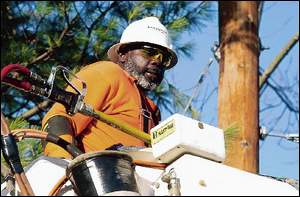
Power play at JCP&L
Relations poor 1 year after strike
12/4/05 - Posted from the Daily Record newsroom
It was a year ago this week that Jersey Central Power & Light workers went on strike. Though they've been back on the job for nearly nine months, the relationship between the state's second-largest utility and the union remains in tatters. The International Brotherhood of Electrical Workers has filed grievances against the company about alleged contract violations. Some workers, while enjoying their work, feel disenchanted with a company for which they have worked for years. "My own impression is that we are nameless, faceless people to this company," said Jackson resident Bill Perry, a lineman. A meeting set for Monday represents the first time that both sides will have met to discuss their relationship in two months, said Willis D. "Chubby" Wardell Jr., president and business agent of System Council U-3, which represents the five IBEW locals that went on strike. "We have been trying, but we really haven't established any good working relationship with the company," he said. "I get a feeling that the relationship is on the back burner for the company so we are not going any place." JCP&L president Steve Morgan said company and union leadership have met a number of times. "Any issue that they have brought to our attention has been dealt with. That is not to say they have always gotten the answer they want." Some of the issues go back to a period of time before the strike, he added. Thursday marks the one-year anniversary of the strike's start, the day about 1,350 workers set up picket lines after talks on a new contract fell apart. The strike exacerbated a relationship between the company and its employees that already was strained. The workers, who had previously rejected a contract proposal in September 2004, were rankled by proposed health-care cost increases and rules governing how employees report to work in their off hours during emergencies. Settled in March The contract talks were only settled in March after the intervention of acting Gov. Richard Codey and then-New Jersey Labor and Workforce Development Commissioner Thomas D. Carver, who oversaw a marathon bargaining session. The four-year contract, supported by the company and union leadership, gave 3 percent annual pay raises, increased workers' share of health care costs and changed work rules. Both sides had to compromise. The utility compromised by agreeing to compensate workers for being on call for emergencies by adding 50 cents an hour to their overall pay. Previously, the company wanted employees to be on call without being paid for it. Workers agreed to take on an increasing share of their health care costs and pay for dental and vision coverage themselves at group rates. In retrospect, union members said they continue to support their decision to go on strike. "Absolutely it was worth it," said Perry, the lineman. "That was a hard time for all of us. No one thought it was a joke or fun. I agreed with them (fellow union members), and I don't regret doing that now." Perry has recovered some from the financial toll of the 98-day strike by working a lot of overtime. But the decisions he had to make at the time, such as borrowing from his 401(k) and refinancing the mortgage on his Jackson home to meet living ex-penses, linger. The strike was the right choice, said Ocean resident Lars Bergrud, a trouble shooter for JCP&L. "Someplace along the line we had to show the com-pany they were not going to take everything away from us that it took 50, 60 years to gain," said Bergrud, who also is a member of Local 1309's executive board. Relations between the work-ers and the company are poor. Employees know they have good jobs, said Edward Penney, a lineman and shop steward of Local 1309. "What they wish there would be is better communication be-tween the management and the union," said Penney of West Long Branch. "We don't trust each other." Morgan said the company has taken steps to improve the relationship. For starters, it welcomed the workers back. "We made a point of prepar-ing management that there would not be any personal is-sues," Morgan said. "These em-ployees had the right to strike, and they would be treated with respect and dignity." Work rule changes were made slowly, he said. For in-stance, a new seasonal shift was staffed with employees who vol-unteered for it, Morgan said. "We didn't jump out of the box and compel people to make big sweeping changes over-night," Morgan said. But some people still are go-ing to have "some lingering hard feelings. Some legitimate, some maybe not," Morgan said. Morgan said the company needs to make decisions based on the interests of customers, shareholders and employees, not just one group. "If the only situation is not to change, then unfortunately we are going to be at an impasse," he said. Wardell said things between the union and JCP&L remain as strained as they were prior to the strike. The union doesn't feel that the company is living up to the new contract, the union leader said. For instance, it has filed grievances regarding the com-pany's use of contractors for overtime work, as well as for an alleged violation of the work rule involving lineman working in the rain. Typically line workers don't work on "live" electrical wires in the rain unless it's an emergency, Wardell said. "It seems like every time we get to a point where things seem to be calming down, labor-relations wise, the company then comes in with a violation to our most recent contract," Wardell said. People get upset and the union ends up filing a griev-ance. "That keeps the relation-ship distant or boiling," War-dell said. The aftermath of the compa-ny's now-discarded policy re-garding emergency call-outs, a particularly sore point, contin-ues as well. Starting in late 2002, the company required workers to carry a beeper or cell phone so they could be reached at all times to respond to work in the event they were needed in an emergency, the union has said. Previously, the company called workers until they had enough to do the work. In early 2003, union officials said there were more than 200 suspensions, some of which were for failing to answer the telephone at home when they were being called in to work because of outages. Morgan, who took the job as president in December 2003, later rolled back the suspensions and paid back pay. Late last year, before the strike, an arbitrator said JCP&L's call-out policy was not in accordance with the labor agreement between the company and the union. The arbitrator also awarded $16.1 million to the union em-ployees, according to a quarterly financial report filed with the Securities & Exchange Commission by JCP&L's parent, FirstEnergy Corp. In October, JCP&L filed an appeal in federal court to vacate the award. "Arbitration is binding, but they chose not to accept the ar-bitrator's answer and decided to take us to court," Wardell said. Morgan said the appeal is part of the process. The arbitrator's decision, he said, was "flawed." Workers continue to chafe under the new call-out policy. Under that policy, two workers in each of several geographic areas are required to carry a cell phone and must respond if an emergency occurs. The phone is first given to those who volunteer; afterward, it is assigned to workers, Wardell said. A worker can only be forced to take it once every four weeks, he added. Ocean resident Alex Delonardo, a lineman who has worked for JCP&L for 12 years, said it is stressful. "You are very conscious of it, and it alters your lifestyle," Delonardo said. "When I have it, I toss and turn all night waiting for the phone to ring." Good relations are not just important for the company's present, but for its future as well. Cherry Hill resident Harold Ammond, a labor relations consultant, said both sides in any labor dispute must understand and come to grips with the underlying problems not settled by a strike so they can move on. "It gives both parties an op-portunity to get their position out there so when you reach the collective bargaining table three years from now, you basically have the solution to the problem," Ammond said. "If you don't address it, it is going to fester, and it is going to blow up again."
IBEW Local 702 (West Frankfort IL) and Consolidated Communications Ratify Labor Contract
Consolidated Communications and IBEW Ratify Labor Contract
MATTOON, Ill., Nov. 30 /PRNewswire-FirstCall/ -- Consolidated Communications Holdings, Inc. and the International Brotherhood of Electrical Workers (IBEW) Local Union No.702 today announced membership ratification of a new three-year labor agreement. The contract is retroactive to November 15, 2005 and will continue through November 15, 2008 and covers more than 400 hourly employees in Illinois, including operators, technicians, customer service representatives and clerical employees.
"We have enjoyed excellent labor relations and are pleased with the outcome of this negotiation," said Bob Currey, president and chief executive officer of Consolidated Communications.
"Consolidated has been an excellent employer for our members," said Ed Phillips, Business Representative of IBEW Local No. 702. "We reached a fair agreement covering the next three years and look forward to a continued strong relationship with Consolidated in the future."
About Consolidated Communications
Consolidated Communications Holdings, Inc. is an established rural local exchange company (RLEC) providing communications services to residential and business customers in Illinois and Texas. Each of the operating companies has been providing service in its local markets for over 100 years. With approximately 245,000 local access lines and approximately 36,000 digital subscriber lines (DSL), Consolidated Communications offers a wide range of telecommunications services, including local dial tone, custom calling features, private line services, long distance, dial-up and high-speed Internet access, carrier access and billing and collection services. Consolidated Communications is the 15th largest local telephone company in the United States.
About The International Brotherhood of Electrical Workers (IBEW)
The International Brotherhood of Electrical Workers (IBEW) represents approximately 750,000 members who work in a wide variety of fields, including utilities, construction, telecommunications, broadcasting, manufacturing, railroads and government. The IBEW has members in both the United States and Canada and stands out among the American unions in the AFL-CIO because it is among the largest and has members in so many skilled occupations.
Safe Harbor
This release contains forward-looking statements regarding future events and the future performance of Consolidated Communications Holdings, Inc. that involve risks, uncertainties and assumptions that could cause actual results to differ materially including, but not limited to, economic conditions, customer demand, increased competition in the relevant market and others. Please see the section entitled "Risk Factors" in our prospectus dated July 21, 2005, as well as the documents that we file from time to time with the Securities and Exchange Commission, such as the Company's Form 10-Q for the quarter ended September 30, 2005, which contain additional important factors that could cause our actual results to differ from our current expectations and from the forward-looking statements discussed during in this presentation. Because of these risks, uncertainties and assumptions, you should not place undue reliance on the forward-looking statements. Furthermore, forward-looking statements speak only as of the date they are made. We do not undertake any obligation to update or review any such forward-looking information, whether as a result of new information, future events or otherwise.
Consolidated Communications Holdings, Inc.
CONTACT: Laura ZuHone, Director - Corporate Communications ofConsolidated Communications, +1-217-234-5965, Laura.ZuHone@consolidated.com;or Investor Relations: Kirsten Chapman, or David Barnard, David@lhai-sf.com,both of Lippert / Heilshorn & Associates, +1-415-433-3777, for ConsolidatedCommunications
Web site: http://www.consolidated.com/
http://www.redorbit.com/news/display/?id=317069
Published: 2005/11/30 09:00:27 CST
© RedOrbit 2005
RIP, Brother Harold Thorpe, JR. "BUD"
RIP:
Retired IBEW Local #43 & #328 Member Harold J. "Bud" Thorpe Jr., 58, 12/1/2005
Harold J. "Bud" Thorpe Jr., 58 of 82 County Route 24, Minetto died Thursday in the Oswego Hospital.
He was born the son of the late Harold, Sr. and Katherine Thorpe
Mr. Thorpe retired as a Master Electrician from the IBEW Local #43, Syracuse and Oswego IBEW Local #328.
He was a member of the AFL/CIO, and he was the representative [delegate] for the IBEW Local #43 at the International Convention in 1996.
Mr. Thorpe was a professional photographer, and he was the President of the Oswego County Housing Development.
Mr. Thorpe was predeceased by his wife Dorothy A. Thorpe in 1992.
He is survived by his wife Dorothy "Sam" Thorpe of Minetto his sons Harold "Bud" Thorpe III of Oswego, James Thorpe of Baltimore, his daughter Kathleen A. Thorpe of Denver, his stepchildren Lawrence Burke of Oswego, and Colleen Holliday of Pulaski, his grandchildren Kelsie Burke, Carissa Holliday, Lawen Burke, and Coltin Holliday, his aunt and cousins.
Funeral services will be conducted Monday 10:00 a.m. from the Sugar and Scanlon Funeral Home, Oswego and 11:00 a.m. in St. Paul Church where a Mass of Christian Burial will be celebrated by Rev. Eric Harer. Burial will be in St. Peter’s Cemetery.
Calling hours will be Sunday 5:00 –8:00 p.m. at the funeral home 147 West Fourth St., Oswego.
In lieu of flowers the family has requested contributions be made to the American Cancer Society.
eZ publish™ copyright © 1999-2004 eZ systems as
Minneapolis Electrical Inspectors (IBEW Local 292) May be Eliminated by Council
City hands electrical inspections over to state
By Scott RussellUnion inspectors may ask new Council to reverse decision eliminating program by April 30
The city of Minneapolis has ended its electrical inspections program, turning the duties over to a state program in a move city leaders say will speed up service and save money for customers and the city.
An official from the International Brotherhood of Electrical Workers (IBEW) calls the city's financial analysis flawed.
The City Council voted Sept. 23 to end the city program. As of Oct. 1, the city stopped issuing electrical permits. Anyone seeking an inspection now has to get a state permit. A recent agreement allows city inspectors to work until April 30, 2006, or until they find other work.
City Councilmember Lisa Goodman (7th Ward) supported the change, based on the savings for her constituents. “The fact that eight [Councilmembers] would vote to do the right thing shocks me, actually,” she said, referring to labor opposition.
Steve Claypatch, business manager for IBEW Local 292, said the vote happened fast, and the city did not reach out to the union and the contractors who use the city inspection system to discuss the change. The Council itself was ill-informed about the costs and benefits, he said.
“The city has one of the premiere inspections departments in the nation,” he said. “We are proud to be part of that.”
The city has had 10 electrical inspectors who reviewed new electrical work. They have worked without a contract since April 2004, disputing the city's 2 percent wage increase policy.
The IBEW took the city to District Court, claiming it had not bargained in good faith. Judge Harry Crump issued a temporary restraining order on the city's decision to eliminate the program, and ordered the two sides back to the table.
The contract and legal dispute are being resolved. The Council voted 12-0 Nov. 18 to approve the new contracts, with a 1.6 percent across the board increase for 2004-2005 contract and 1.4 percent across the board increase for 2005-2006, plus the automatic increases based on years of service. It also voted to settle the lawsuit.
Henry Reimer, head of City Inspections, said the city agreed to employ the inspectors through April 30, the end of the contract. In return, the union would drop the lawsuit. He said the inspections backlog on permits issued prior to Oct. 1 would keep them busy.
“It gives them transition time to make plans,” he said. “What we want is some certainty. The lawsuit hinders our ability to plan.”
Extending the inspectors' employment through April 30 buys more time for lobbying. Claypatch said union members plan to talk to members of the incoming Council about reviewing the decision. “Not to look at it would be foolish,” he said.
By the numbers
On its face, the change appears to save permit-buyers money.
The minimum electrical inspections fee charged by the city is $60.50, according to information from the City Inspections Department. The minimum fee under the state program is $20.50.
The city inspection fee for a new 200-amp service with 40 circuits in a one- to two-unit family dwelling costs $499.50, the Inspections Department said. Under the state program, it is $81.50, or $418 less. A city permit for an electrical inspection of a 40,000-square-foot office building with 92 circuits costs $805.50; the state charges $460.50, or $345 less.
Claypatch says blaming the inspectors for high fees is “garbage.” The Council - not the inspectors - set the fees. If the issue is high fees, the city should lower them, not eliminate the program, he said.
Reimer agrees the Council sets the fees. However, the city has to charge enough to recoup costs. “Our fees are high, [yet] we still are losing money on the program,” he said.
Reimer points to a city fee study that says the city could save money by jettisoning the program.
In 2004, the city collected $1.26 million in electrical permit fees. It paid $1.02 million in salary and fringe benefits to inspectors and customer service representatives, the study said.
By that measure - counting direct service costs - the city actually got $240,000 from the electrical inspections program in 2004.
However, the program had $679,000 in administrative overhead in the Regulatory Services Department and from indirect overhead - vehicles, computers, legal costs, human resources and a fractional share of citywide costs, such as the City Council and mayor's budgets, the consultant's analysis said.
By that measure - including direct costs and all possible overhead - the electrical inspections program cost $437,000 in 2004. Whether the city gains or loses under the new model depends on how much it cuts the various overhead costs.
Claypatch is looking into the city's analysis, and says the $679,000 overhead costs are out of line for 10 inspectors. “They just loaded it up with administrative costs,” he said.
Reimer said salaries are typically less than half the actual cost of a full-time employee in both the public and private sector. The Finance Department would give his department a targeted cut for 2006. “The Council will expect cuts to offset the loss of revenue,” he said.
One thing is clear, the change in inspections and electrical inspectors settlement will cost the city money next year. It will not collect electrical permit revenue but will continue to pay inspectors. The amount is unknown, but it could be in the $300,000 range.
State inspectors are not state employees, but independent contractors licensed by the state, Reimer said.
Lost services?
If the issue goes back to the Council, expect several disputes to emerge.
- One-stop shop: Claypatch said the change hurts the city's one-stop shop for developers - where they could get all needed permits and reviews from one office.
Reimer agrees the change would create an extra stop, but people pulling permits would pay less. “I don't think they will complain too loudly,” he said.
- Fixing existing violations: Claypatch said the city's in-house inspectors could cite housing code violations of existing electrical work while inspecting new installations. State inspectors could not, allowing electrical hazards to continue, he said.
Reimer disagreed, calling it a red herring. State inspectors are bound by ethics and contract to follow up with hazardous situations, he said. Further, the city has kept the authority to inspect existing electrical work and continues to employ housing inspectors.
- Extra fees: Claypatch said the city historically had not charged government units - such as public housing, public works, the libraries, etc. - for electrical permits. That is one reason the program appeared to be expensive, he said.
Reimer said the city has not waived fees as Claypatch suggests. Spokespersons for Public Works, the Minneapolis Public Housing Authority, the Minneapolis Library Board, and the Minneapolis Park and Recreation Board all said they have been paying for city electrical permits.
Subscribe to:
Posts (Atom)